
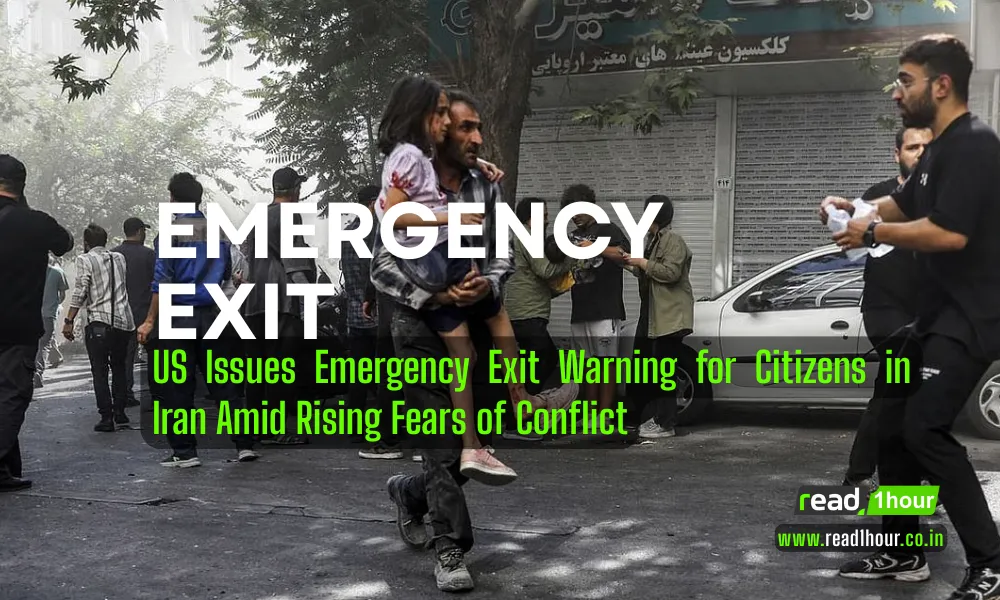
US Issues Emergency Exit Warning for Citizens in Iran Amid Rising Fears of Conflict
read1hour delivers latest news, stock market updates, gadgets, mobile reviews, and trending stories daily.
United States has issued an urgent advisory directing American citizens to leave Iran immediately, sparking intense speculation about rising regional tensions and the possibility of military escalation. While no official confirmation of imminent strikes has been made, the unusually strong language of the warning has drawn global attention and raised concerns across diplomatic and security circles.
The advisory, released by the U.S. State Department, cited a
rapidly deteriorating security environment and warned that Americans in Iran
could face serious risks, including arbitrary detention, limited consular
access, and sudden travel restrictions. Officials emphasized that U.S. citizens
should not expect government assistance if conditions worsen.
The emergency order follows days of heightened tensions in
the Middle East, including aggressive rhetoric, military movements, and
intelligence assessments suggesting increased instability. Analysts note that
such advisories are rare in their urgency and often signal that governments are
preparing for worst-case scenarios, even if military action is not guaranteed.
Iranian authorities have not directly responded to the
advisory, but state-aligned media outlets dismissed foreign warnings as
political pressure tactics. Meanwhile, regional allies and international
observers are closely monitoring developments, concerned that miscalculations
could quickly escalate into broader conflict.
U.S. officials stopped short of confirming any plans for
military strikes, stressing that the advisory is a precautionary measure
designed to protect civilians. “The safety of American citizens is our top
priority,” a senior official said, adding that the situation remains fluid and
unpredictable.
Experts say evacuation warnings are often issued when
diplomatic channels narrow and intelligence agencies detect potential threats.
However, they caution against assuming that conflict is inevitable. “These
alerts are about readiness, not declarations of war,” said a former U.S.
defense analyst. “But they do indicate serious concern.”
The warning has also affected global markets, with oil
prices showing volatility amid fears of disruption in one of the world’s most
sensitive energy regions. Airlines and shipping firms are reviewing routes,
while neighboring countries are preparing contingency plans in case tensions
spill over borders.
For ordinary Iranians, the situation adds to existing
uncertainty. Economic pressures, sanctions, and political tensions have already
strained daily life, and fears of international confrontation only deepen
anxiety. Humanitarian organizations have urged restraint from all sides and
called for renewed diplomatic engagement.
As of now, diplomatic efforts continue behind the scenes,
with international mediators urging de-escalation. Whether the advisory signals
imminent action or is simply a precaution remains unclear. What is certain is
that the warning reflects a moment of heightened risk—one that the world will
be watching closely in the coming hours and days.