
India Eyes New Global Markets As US Trade Deal Remains Uncertain And Delayed
India looks to diversify exports and strengthen new trade partnerships as uncertainty continues over a stalled US trade deal.
As negotiations over a long-anticipated India–US trade deal remain stalled, India is increasingly turning its attention toward new global markets to sustain export growth and economic momentum. Government officials and trade analysts say New Delhi is actively diversifying its trade partnerships amid uncertainty over the pace and scope of an agreement with Washington.
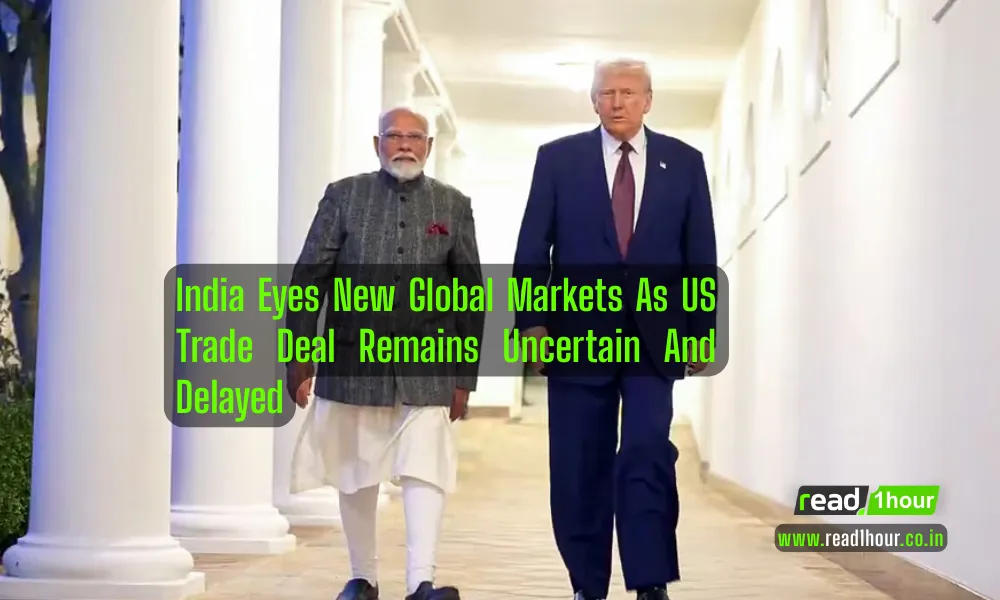
Despite multiple rounds of talks, key differences between
India and the United States persist, particularly on market access, tariffs,
digital trade rules, and agricultural imports. While both sides continue to
express optimism, the lack of a clear timeline has prompted Indian policymakers
to reduce overreliance on any single trading partner.
In response, India has accelerated efforts to strengthen
economic ties with regions such as Europe, Africa, the Middle East, and
Southeast Asia. Trade delegations have increased engagement with countries
in the Gulf Cooperation Council, Latin America, and emerging African economies,
focusing on sectors like pharmaceuticals, electronics, textiles, engineering
goods, and renewable energy.
Officials say this strategy aligns with India’s broader
goal of becoming a global manufacturing and export hub. Under initiatives such
as “Make in India” and “Atmanirbhar Bharat,” the government is
encouraging domestic production while simultaneously expanding access to
international markets. Analysts believe this dual approach helps shield the
economy from geopolitical uncertainty and shifting trade alliances.
The European Union has emerged as a key focus area, with
renewed talks on a long-pending free trade agreement gaining momentum.
Similarly, India has expanded trade cooperation with Australia and strengthened
partnerships across ASEAN nations. These efforts are seen as practical
alternatives as negotiations with the United States remain unresolved.
Exporters, however, continue to view the US as a critical
market. Industry groups warn that prolonged delays could limit growth
opportunities, especially in information technology services, pharmaceuticals,
and high-value manufacturing. Still, many businesses acknowledge that
diversification offers long-term stability and reduces vulnerability to
political and policy shifts.
Economists note that global trade patterns are evolving
rapidly, shaped by supply chain realignments, rising protectionism, and
regional trade blocs. In this environment, India’s outreach to multiple markets
reflects a pragmatic response rather than a retreat from US engagement. “This
is not about replacing the US,” one trade expert said. “It’s about balancing
risk and opportunity.”
The Indian government has also pushed for improved
logistics, faster customs clearances, and trade-friendly regulatory reforms to
boost export competitiveness. These domestic changes, analysts say, will
support India’s global ambitions regardless of how US negotiations progress.
While talks with Washington continue behind the scenes,
officials remain cautious about expectations. Any eventual agreement, they say,
must protect domestic interests while expanding trade opportunities. Until
then, India’s global trade strategy appears focused on building resilience
through diversification.
As uncertainty around the US trade deal persists, India’s
outreach to new markets signals a clear message: the country is determined to
expand its global footprint and secure sustainable growth, even in a shifting
international trade landscape.