
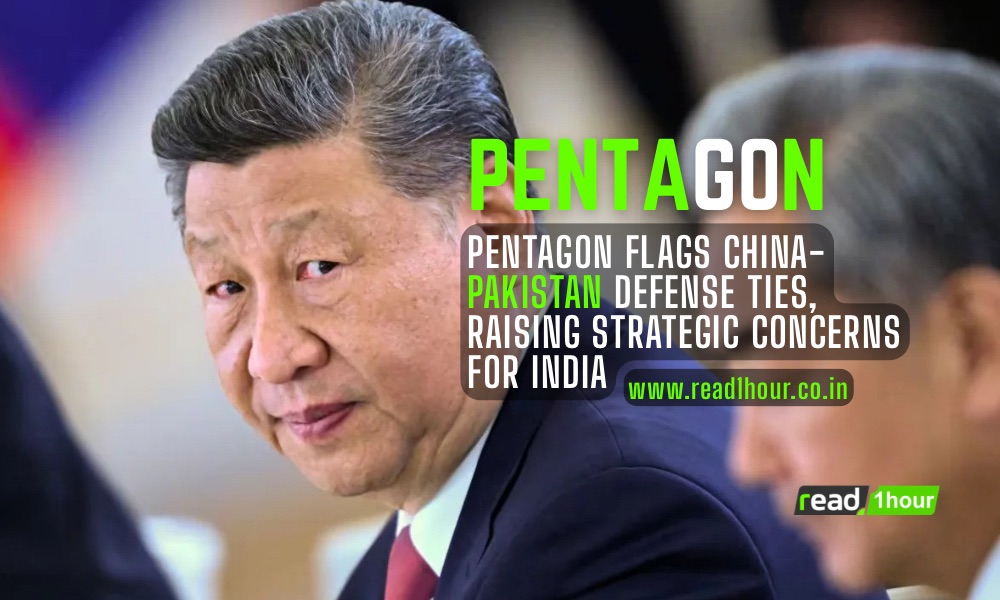
Pentagon Flags China-Pakistan Defense Ties, Raising Strategic Concerns For India
Pentagon report warns of expanding China-Pakistan defense and space cooperation, raising new strategic concerns for India.
United States has raised a strategic red flag for India after a Pentagon report highlighted deepening defense and space cooperation between China and Pakistan. The assessment, included in the U.S. Department of Defense’s latest annual review, points to growing military alignment between Beijing and Islamabad that could reshape regional security dynamics in South Asia.
According to the report, China continues to expand its role as Pakistan’s primary defense partner, supplying advanced military hardware, joint weapons development, and expanding collaboration in space and satellite technologies. The Pentagon described the partnership as “increasingly integrated,” noting that it has implications beyond bilateral ties and directly affects India’s strategic environment.
The report highlights that China has supported Pakistan’s military modernization through fighter aircraft programs, naval platforms, missile systems, and intelligence-sharing mechanisms. Joint production projects, including combat aircraft and drones, have strengthened Pakistan’s operational capabilities. U.S. defense analysts say these developments could complicate India’s security calculus, particularly along its western borders.
Space cooperation emerged as a key area of concern. The Pentagon noted that China has assisted Pakistan in satellite launches, space-based surveillance, and communications infrastructure. Such capabilities can enhance Pakistan’s battlefield awareness and coordination, raising alarms among regional observers about potential dual-use applications that could support military operations.
Indian strategic experts say the report validates long-standing concerns in New Delhi about a two-front security challenge, with China and Pakistan increasingly coordinating military strategies. While India maintains strong defense readiness, analysts believe closer China-Pakistan cooperation could require India to accelerate its own modernization efforts, particularly in space, cyber, and intelligence domains.
The U.S. assessment also reflects Washington’s broader Indo-Pacific strategy, where India is seen as a key partner in maintaining regional stability. American officials have repeatedly emphasized the importance of transparency and balance in defense partnerships, especially in regions marked by historical tensions and unresolved disputes.
Despite the warning tone, the Pentagon report does not suggest immediate escalation. Instead, it underscores long-term strategic shifts that could influence future military planning. Analysts say the findings are likely to be closely studied by Indian policymakers as they evaluate defense procurement, alliances, and technological investments.
China and Pakistan have consistently described their relationship as an “all-weather strategic partnership.” Both nations maintain that their cooperation is defensive in nature and not directed at any third country. However, the scale and scope of collaboration outlined in the U.S. report suggest a growing alignment that could alter power balances in South Asia.
As geopolitical competition intensifies, experts believe India will continue strengthening partnerships with countries such as the United States, Japan, France, and Australia while enhancing indigenous defense and space capabilities. The Pentagon’s warning serves as a reminder that regional security equations are evolving—and India’s strategic decisions in the coming years may prove decisive.