
New Poll Warns Trump As Independents Drive Massive Support Collapse
read1hour delivers latest news, stock market updates, gadgets, mobile reviews, and trending stories daily.
A newly released national poll is raising fresh warning signs for Donald Trump, showing a 23-point overall deficit and an even sharper 43-point gap among independent voters. The findings suggest growing challenges for the former president as voter sentiment appears to be shifting away from him at a critical moment in the political cycle.
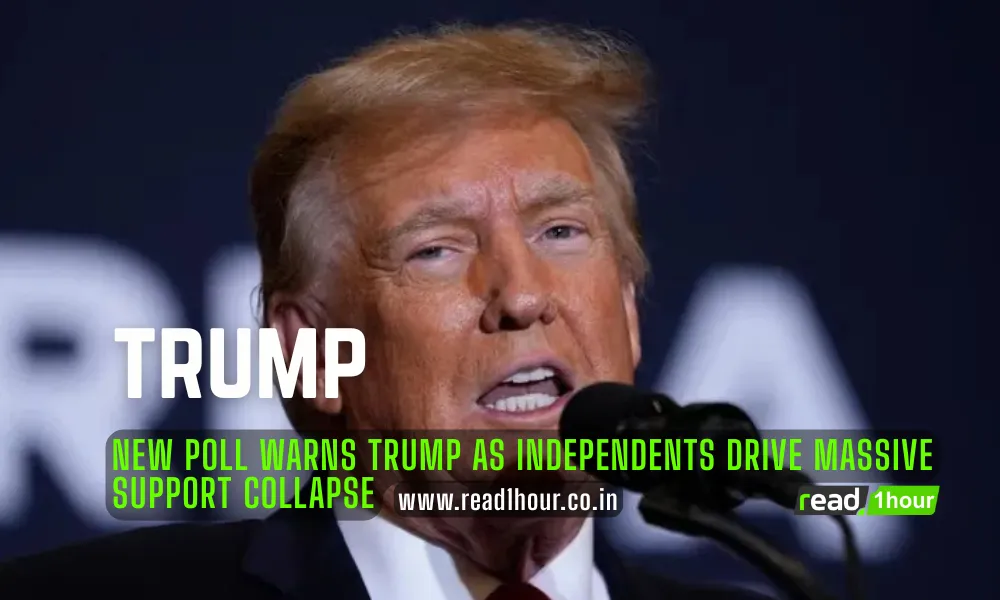
According to the poll, Trump’s support among independents —
a group that often decides close elections — has weakened significantly.
Political analysts say this shift could prove decisive, especially in swing
states where independent voters make up a large share of the electorate. While
Trump maintains strong backing within his core base, the widening gap outside
it is becoming increasingly difficult to ignore.
The data indicates that independents are expressing concern
over leadership style, political stability, and long-term governance
priorities. Many respondents cited fatigue with political conflict and
uncertainty, signaling a desire for a more predictable and unifying approach.
Analysts note that these attitudes are influencing voter preferences more than
party loyalty.
The 23-point overall deficit reflects broader
challenges as well. Suburban voters and younger demographics are showing
declining enthusiasm, according to polling breakdowns. While Trump continues to
dominate among loyal supporters, his appeal appears limited beyond that base.
Experts argue that without a shift in messaging, regaining independent support
may be difficult.
Campaign strategists say polls should be viewed as snapshots
rather than predictions. However, repeated trends showing erosion among
independents could force a strategic recalibration. Political consultants
suggest that economic messaging, public safety concerns, and a more disciplined
campaign tone could be necessary to close the gap.
Trump’s allies have questioned the methodology of the poll,
emphasizing that voter turnout and enthusiasm on Election Day matter more than
survey results. They argue that past elections have shown polling inaccuracies,
particularly in underestimating Trump’s base. Still, even supporters
acknowledge that independent voters remain a critical weakness.
Meanwhile, opposition campaigns are using the data to
highlight what they describe as declining trust in Trump’s leadership.
Messaging efforts are increasingly focused on appealing to independents by
emphasizing stability, institutional norms, and forward-looking policies. The
sharp 43-point deficit among independents is being framed as evidence of a
broader shift in political attitudes.
Political scientists say the poll reflects a changing
electorate that is less tolerant of polarization. Independent voters, in
particular, are showing greater willingness to move away from familiar
political figures if they feel governance concerns are not being addressed.
As the campaign season continues, future polling will be
closely watched to see whether Trump can reverse the trend or if the warning
signs deepen. For now, the numbers suggest a challenging road ahead — one where
independent voters may hold the decisive power in shaping the outcome.