
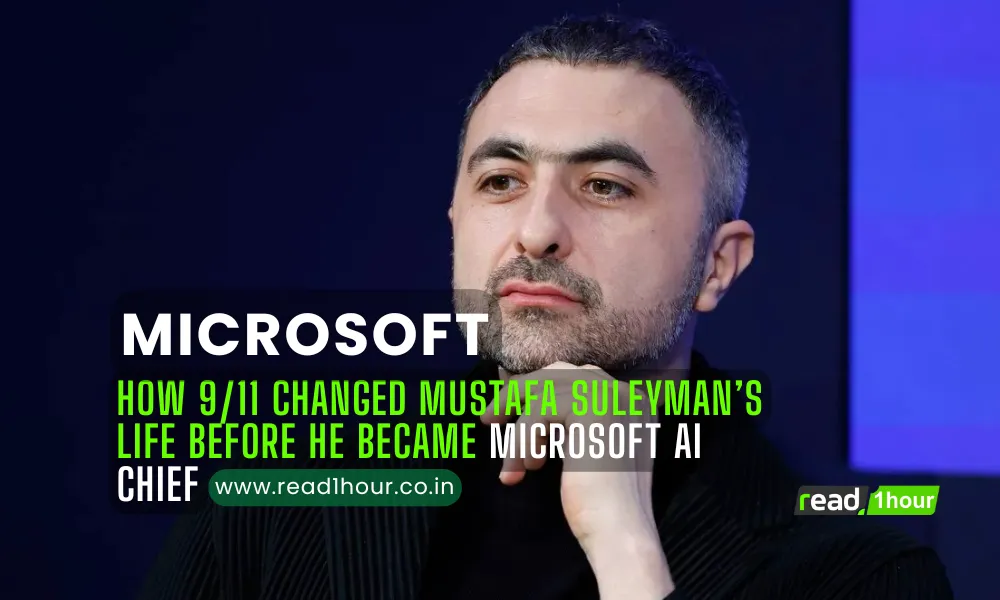
How 9/11 Changed Mustafa Suleyman’s Life Before He Became Microsoft AI Chief
read1hour delivers latest news, stock market updates, gadgets, mobile reviews, and trending stories daily.
Life of Mustafa Suleyman, now one of the most influential figures in global artificial intelligence and the CEO of Microsoft AI, took a dramatic and defining turn when he was just 19 years old. His decision to leave Oxford University’s Mansfield College shortly after the September 11, 2001 terror attacks marked a turning point that would ultimately shape his future as a technology leader and public thinker.
Suleyman, born in London to a Syrian father and English
mother, was studying philosophy and politics at Oxford when the 9/11 attacks
shook the world. In later interviews, he has described the period as deeply
unsettling, not just globally but personally. The attacks sparked intense
political debate, cultural tension, and identity-related questions that forced
him to reassess his priorities and direction at a young age.
Rather than continuing along a traditional academic path, Suleyman chose to step away from Oxford. Friends and peers at the time viewed the decision as risky, especially given the prestige of the institution. But for Suleyman, the moment demanded real-world engagement. He became increasingly focused on social justice, policy, and how large systems—governments, institutions, and technologies—shape human lives.
His unconventional journey eventually led him into the world
of artificial intelligence. Suleyman co-founded DeepMind in 2010, a
company that would go on to revolutionize AI research before being acquired by
Google. At DeepMind, he became known not only for technical ambition but also
for pushing conversations around AI safety, ethics, and governance—themes
rooted in his early life experiences.
In 2024, Suleyman joined Microsoft as the head of its
consumer AI division, later becoming CEO of Microsoft AI, placing him at
the center of the global AI race. His role involves overseeing products like
Copilot and shaping how AI integrates into everyday digital life.
Observers often point out that Suleyman’s early departure
from Oxford reflects a broader lesson about non-linear success. His life story
challenges the idea that elite degrees are the only path to leadership.
Instead, it highlights how moments of crisis—such as the aftermath of 9/11—can
redirect ambition and purpose in unexpected ways.
Today, as governments and tech companies grapple with the
impact of artificial intelligence, Suleyman’s voice carries weight. His past
continues to inform his present, reminding the world that some of the most
influential leaders are shaped not just by education, but by the courage to
change course when history intervenes.