
Are Corporates Taking Over India? Understanding The Rise Of New Monopolies
Exploring whether corporates are taking over India and how growing monopolies are reshaping key economic sectors.
India’s economic landscape is changing faster than ever, and a growing question is being asked across political, business, and social circles: “Who’s the next Indigo, and are corporates taking over India?” The rise of dominant private players in aviation, retail, digital payments, and infrastructure has sparked a debate about how deep corporate monopoly has reached in the country.
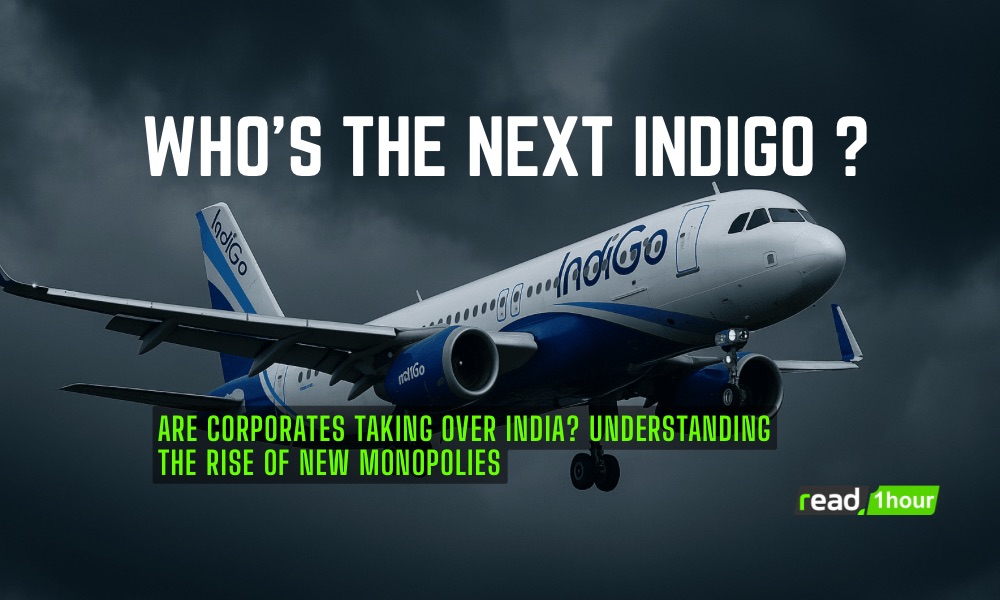
IndiGo’s massive dominance in India’s aviation sector is often seen as an example of modern corporate power. The airline controls more than half of the domestic market, a position achieved through strong fleet expansion, reliable service, and aggressive pricing. But the larger conversation is not just about aviation—it is about how several sectors are showing similar patterns of growing consolidation.
Experts suggest that India’s booming economy naturally favors large businesses that can scale quickly. Sectors such as e-commerce, telecom, digital finance, energy, and transport have seen rapid consolidation. Companies with access to capital, technology, and logistical strength continue to outgrow smaller competitors. This trend is pushing India’s business ecosystem into what analysts call an era of “super corporates.”
Recent data reveals that big conglomerates—ranging from tech-driven giants to traditional industrial leaders—are rapidly expanding into new territories. For example, India’s retail and digital payment ecosystem has become strongly influenced by a few key players. Meanwhile, infrastructure sectors such as ports, airports, highways, and renewable energy are increasingly dominated by large corporations that can handle long-term investment demands.
Supporters of this model argue that strong corporate-led development brings efficiency, economic growth, and global competitiveness. They point to improved connectivity, falling data costs, better logistics, and world-class infrastructure powered by private companies. Government partnerships with corporates have also accelerated modernization, especially in aviation, power, and digital services.
However, critics warn that growing concentration of market power could limit competition and reduce consumer choice. Small businesses, startups, and regional companies often struggle to survive in an environment where bigger firms scale faster and control supply chains. Analysts caution that India must balance corporate-led growth with policies that protect innovation, competition, and fair market access.
The rise of near-monopolies also raises concerns about influence in policymaking. As corporations grow in size, their ability to shape regulations and market conditions increases. Economists argue that transparent oversight and strong competition laws are essential to prevent scenarios where a few companies dominate entire sectors.
So, “Who’s the next IndiGo?” The answer depends on sectoral trends. In digital payments, one or two players already dominate. In renewable energy and ports, large conglomerates are growing at unprecedented speed. In retail and e-commerce, consolidation continues as major companies expand aggressively. The pattern suggests that India’s next market leader may emerge in technology-driven sectors such as fintech, electric mobility, and artificial intelligence companies.
India’s economic future will likely involve a mix of strong corporates and dynamic smaller players. The key question is whether the country can maintain a healthy balance—one that allows big businesses to innovate while ensuring fair competition for all.